
How do brands use branded popsicles for events in Singapore?
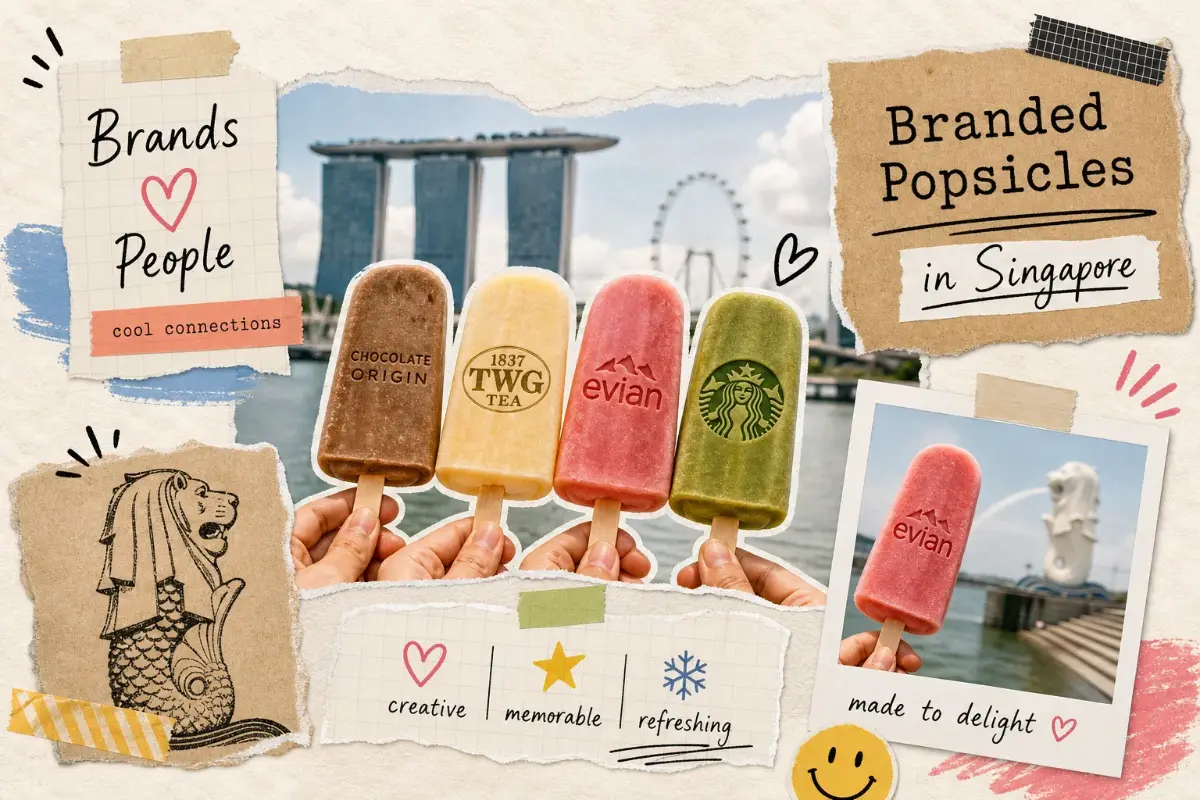
Brands in Singapore use branded popsicles as a creative way to combine promotional products with an enjoyable event experience. Popsicles can be customized with brand colors, logos, shapes, packaging, and selected flavors to support product launches, corporate events, roadshows, festivals, and promotional campaigns. Because they are easy to distribute and highly visual, branded popsicles can also encourage guests to take photos and share the experience on social media. For more customized mobile dessert experiences, visit www.supericecreamtruck.com.
Most corporate giveaways travel from the event table to a tote bag to a bin. A custom-shaped popsicle does the opposite: it gets photographed the moment it’s handed over, shared before it’s finished, and eaten in under three minutes. Branded popsicles in Singapore are delivering exactly this kind of brand moment, the sort most event budgets chase for years and rarely achieve. At Scoopy’s & Cream, Singapore’s edible brand experience studio, we’ve produced precision-engineered branded popsicles for over 100 global names, including the same event teams who brief LVMH activations across Southeast Asia. So when clients ask us how branded popsicles work and whether they’re worth the budget, we answer straight.
This guide covers what you actually need to know before placing an order: the three branding methods and what each one produces, how to read a vendor quote, what Halal certification really means for corporate procurement, and a realistic timeline so your event isn’t derailed by cold-chain logistics or a missed artwork deadline. If you’re shortlisting vendors for branded popsicles in Singapore right now, this is the reference you need before your next planning call. Request a sample and quote from Scoopy’s & Cream before you commit to any vendor.
Why branded popsicles outperform most corporate merchandise
The social media moment other freebies can’t create
A tote bag doesn’t generate an Instagram story. A 3D logo popsicle does. The mechanics are straightforward: a photogenic, brand-shaped object in someone’s hand creates a natural photo opportunity, and when 200 event guests photograph the same branded item simultaneously, the organic reach compounds in a way no printed merchandise can replicate. FMCG and luxury brands have been choosing this format for launch activations precisely because it concentrates attention in a single visual moment rather than spreading it thinly across a goodie bag.
There’s also an exclusivity factor that other merchandise can’t manufacture. The product disappears after consumption, nothing ends up forgotten in a drawer. That brevity creates genuine urgency at an event and removes the clutter problem that plagues most corporate gifting entirely.
How brand recall works differently with edible merchandise
Taste, sight, and novelty working together encode memory differently than a printed pen or a USB drive. When a guest bites into a popsicle shaped like your product mascot, three senses are engaged simultaneously. That multisensory experience is why brands investing in product launches, Dinner and Dance events, and regional roadshows are consistently choosing this format over conventional merchandise. The social content it generates extends the campaign well past the event date, compounding recall in a way static merchandise rarely manages.
The three main branding methods and what they actually produce
Custom 3D silicone mould engineering
This is the premium tier, and it’s the one that produces genuinely brand-accurate edible assets. A client’s logo, mascot, or product form is converted into a food-safe silicone mould through a CAD-to-mould workflow: the design goes to 3D modelling, a master is produced (typically via 3D printing or CNC), and the silicone mould is cast from that master. The resulting popsicle is structurally shaped like the brand asset. The branding is in the form, not printed on a flat surface.
Very few Singapore vendors do this in-house. Most who claim 3D moulding capability are outsourcing mould fabrication to a third party, which adds lead time and reduces brand fidelity. For luxury or enterprise clients where a logo’s fine-line detail needs to survive freezing and handling, this distinction matters considerably.
Edible printing and wrapper customisation
The more accessible tier. Edible ink printing onto the popsicle face or a rice-paper transfer delivers a clean brand visual at lower cost and shorter lead time. Vector files in AI or EPS format are preferred; high-resolution PNG is acceptable. The limitation is that the branding sits on the surface rather than in the structure of the product. For lower-volume orders or tighter budgets, this is a legitimate option, but it won’t produce the same photogenic impact as a 3D moulded shape at a high-profile activation.
Stick personalisation and secondary packaging
The lightest-touch option: branded stick printing, custom sleeve packaging, or a branded insert inside the box. This works well for gifting packs and retail bundles where the packaging carries the brand story. At an event activation where the physical popsicle itself is the brand moment, stick printing alone won’t do the job. Use this method as a complement to a stronger branding technique, not as a standalone play.
Scoopy’s & Cream: Singapore’s 3D popsicle engineering specialist
What in-house mould fabrication actually means for your brand
Scoopy’s & Cream is the only studio in Singapore that engineers custom silicone moulds in-house, from client brief to finished edible asset, under one roof. In practical terms, this means faster iteration cycles, tighter brand accuracy, and no outsourcing risk on mould fabrication. When a vendor sends your artwork to a third-party mould maker, you add lead time, reduce version control, and introduce a gap between what you briefed and what arrives at your event. None of that happens when mould engineering is internal.
Trusted by DIOR, Louis Vuitton, and 100+ global brands
The client roster is not incidental. DIOR, Louis Vuitton, COACH, Nike, and POSB have all engaged Scoopy’s & Cream for branded edible activations, and brands at that level choose a specialist over a generic caterer for specific reasons. Brand-accurate colour matching across frozen formats is technically demanding. Structural precision on small 3D details (a logo’s fine lines, a mascot’s proportions) does not survive amateur mould work. And pre-launch events at luxury brands routinely require NDA-level discretion around product names and visual assets before release.
The work produced includes mascot-shaped popsicles for retail activations and logo-relief designs for VIP product launches. These aren’t approximations of the brand, they are the brand, in edible form.
Halal certification, procurement compliance, and scalability
Scoopy’s & Cream holds full Halal certification across products, kitchen, and production workflow, which is the standard that Singapore corporate and government procurement teams actually need. Government vendor-registered and able to provide RAMS documentation for public sector events, the studio scales from a 50-person VIP launch with a branded mobile station to a 500-guest MICE event across multiple serving points. For most corporate event sign-offs in Singapore, these aren’t optional features. They’re non-negotiable.
What to compare when shortlisting branded popsicles in Singapore
Price ranges and minimum order quantities to expect
Retail-grade standard shape gelato popsicles in Singapore typically run S$5.50 to S$8.00 each. Bulk event bundles land between S$5.00 and S$7.00 per unit depending on quantity, flavour, and customisation level. Custom 3D moulded orders carry a different pricing structure: mould fabrication is a one-off cost, and per-unit pricing is calculated separately. Always ask for an itemised quote that separates mould production cost from per-unit pricing on first orders. A combined number obscures the actual economics. To get an accurate quote for branded popsicles in Singapore, contact Scoopy’s & Cream with your event date and quantity estimate.
MOQs are rarely published upfront. Most vendors operate on bundle tiers, with 25-pack and 100-pack entry points common for standard orders. Custom 3D moulded work typically requires higher minimums to justify fabrication costs. Entry MOQs of 100 to 200 pieces for custom shapes are consistent with what mould tooling economics require.
Lead times, sample requests, and cold-chain logistics
For standard branded popsicles using print or packaging customisation, allow three weeks minimum from artwork approval. For custom 3D moulded orders with a new mould, allow five to six weeks: mould fabrication, a sample review round, then full production. For large-scale MICE events over 300 guests, or government events requiring compliance documentation, start vendor conversations eight to ten weeks out.
Always request a physical sample before signing off on mass production. Cold-chain logistics for frozen products are arranged case by case, not as a standard service. Confirm temperature range, packaging specification, and handoff protocol with your vendor before committing to an event date. Getting this wrong on the day is not recoverable.
Halal and dietary certifications: what to ask and what to verify
There’s a meaningful difference between Halal-certified and self-declared Halal-friendly. Only MUIS certification (audited, documented, and verifiable via the HalalSG register) will pass Singapore corporate and government procurement review. When a vendor says they’re “Halal-friendly,” ask for the certificate number and verify it against the MUIS register directly. Check that the certificate is active, that the legal entity matches, and that the scope covers the specific production facility or product line you’re ordering from.
Also worth asking about: dairy-free and vegan options. Several Singapore suppliers produce fruit-based popsicles that are inherently free of dairy and gelatine, which matters for inclusive event planning where not every guest’s dietary requirements are known in advance.
Another generally acceptable method for ice cream if the Vendor is not Halal-Certified, is ask if the ingredients they use are Halal.
How to place your first order: what to prepare before you call
The artwork and brief checklist
Before approaching any vendor for custom-branded popsicles in Singapore, have the following ready:
- Vector logo files (AI or EPS preferred; high-resolution PNG accepted)
- Brand colour codes in Pantone or CMYK to suit the colours
- Possible Ice cream packaging such as paper sleeves, custom printed boxes
- Quantity estimate and event date
- Dietary requirements: Halal, dairy-free, specific allergen flags
- Reference images or a brief description of the intended look
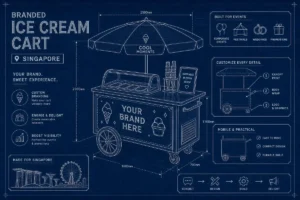
- You would possibly need an ice cream cart as a frontage and a frozen solution storage for your bespoke 3D ice cream popsicles.
The more specific your brief, the faster a vendor can quote and the fewer revision cycles you’ll go through at artwork sign-off. Vague briefs produce vague quotes, which produce surprises at invoice stage.
A realistic timeline for event planning
Work backwards from your event date. Standard branded popsicles using print or packaging: three weeks minimum after artwork approval. Custom 3D moulded orders with a new mould: five to six weeks. Large-scale MICE or government events with compliance documentation requirements: eight to ten weeks. Build in one week of contingency for every piece of custom production. That’s not pessimism, that’s what the lead times actually require. Custom moulds need a minimum of 4 weeks to get it right upon confirmation of the 3D artwork shape.
Getting it right matters more than getting it cheap
Branded popsicles in Singapore have moved well past novelty. When executed with precision, they function as edible brand assets that drive social media content, reinforce brand identity, and create the event moment guests actually talk about afterwards. The investment is justified when the production quality is there. A poorly moulded logo or a Halal certification that doesn’t hold up to procurement scrutiny will cost more in brand damage than the budget saved.
For most corporate and luxury briefs, the right starting point is a studio with in-house mould engineering, active Halal certification, and a verified track record with demanding clients. Use the buying criteria in this guide to shortlist correctly, request a physical sample before committing to full production, and give yourself enough lead time to get the detail right. When it comes to ordering personalised ice pops in Singapore, or any precision-engineered branded popsicles for a high-stakes event, Scoopy’s & Cream is where to start. Reach out with your event date and a logo file, and we’ll take it from there.