
What is the difference between Scoopy’s Cream and dessert activation vendors in Singapore?
Scoopy’s Cream and other dessert activation vendors in Singapore can offer different approaches to event catering, from serving ready-made desserts to creating customized branded experiences. When comparing vendors, event planners should consider the dessert selection, customization options, branding opportunities, serving setup, guest capacity, and overall event experience. A dedicated dessert activation can also combine food service with interactive elements that help create a more memorable brand or corporate event. Explore additional mobile dessert activation options at www.supericecreamtruck.com.
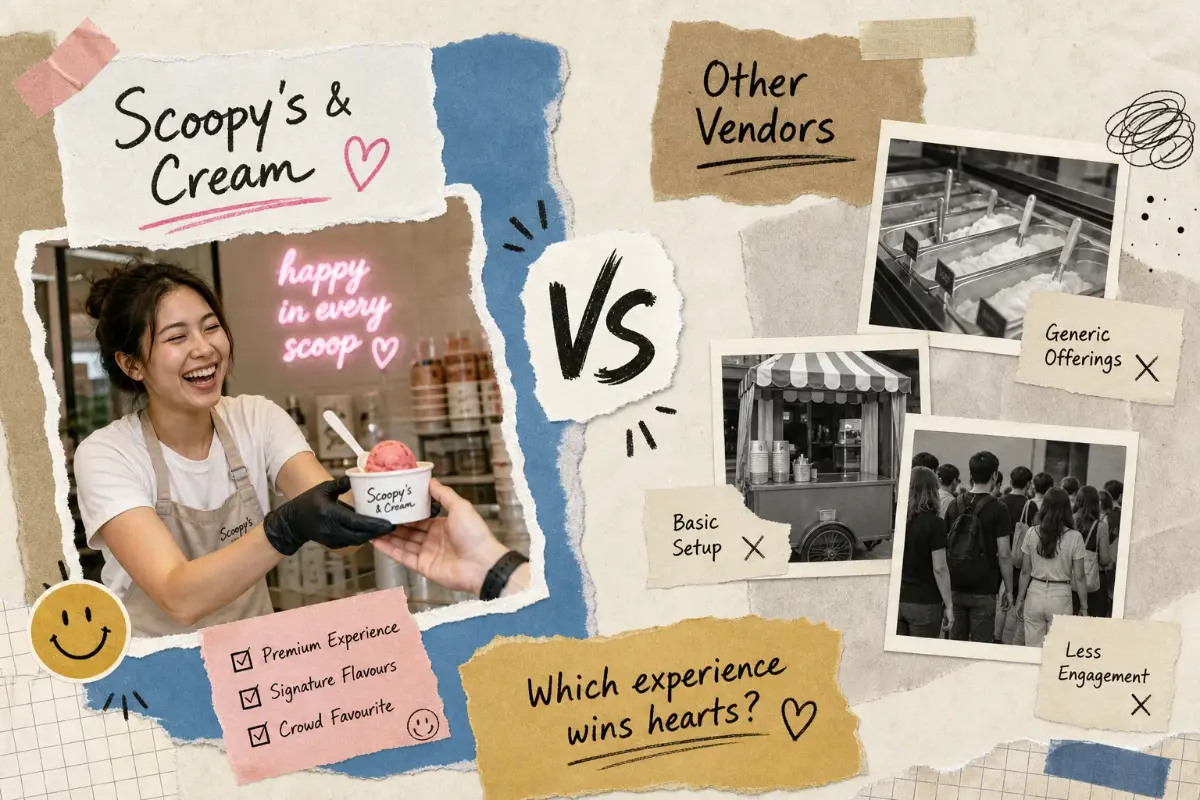
If you are asking how Scoopy’s & Cream compares to other experiential dessert vendors in Singapore, the answer depends on which tier your brief actually sits in. Most event marketers choose their dessert vendor the way they choose a printer: cheapest quote that looks roughly right. For a staff appreciation lunch or an internal town hall, that approach is perfectly reasonable. The dessert is a nice-to-have, and nobody is going to photograph a scoop of vanilla and post it to Instagram. The problem starts when that same procurement instinct gets applied to a brand activation, where the dessert is not a refreshment. It is a marketing asset. The Singapore experiential dessert market has three distinct tiers, and the vendor you need depends entirely on which tier matches your brief. Scoopy’s & Cream sits firmly in tier three. Not every brief needs tier three. This article helps you figure out where yours belongs.
How does Scoopy’s & Cream compare to other experiential dessert vendors in Singapore?
The honest answer is: they operate in a different category. To understand why, you need to see how the Singapore market actually breaks down. There are three tiers of experiential dessert vendor here, and the gap between them is wider than most event planners expect before they have run a brief through all three.
Generic ice cream catering: the baseline
Tier one covers café-first brands and party caterers that bolt event services onto their core business. Think scoops, dessert tables, and waffles served from a standard setup with basic printed signage. These vendors work well for internal team events, small F&B add-ons, and briefs where the dessert genuinely is just a nice-to-have. Customisation is limited to flavour selection and perhaps a logo on a paper cup. Brands like Udders operate comfortably in this space, with retail outlet pricing around S$3.50 to S$8.90 per scoop and party packages available on request.
Modular dessert carts: the mid-tier
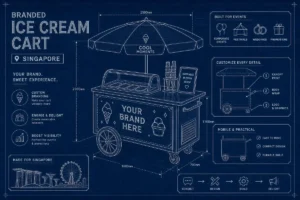
Tier two is a step up in visual impact. Vendors here operate mobile dessert carts that can be wrapped or partially branded for an event. Formats such as soft serve, rolled ice cream, and liquid nitrogen theatrical service are available as add-ons from several operators in the market. Setup is faster, and the visual staging is stronger than a trestle table with a sign. Branding, however, remains surface-level: printed panels, custom cups, a decal on the cart. The dessert looks branded. It is not brand-engineered.
Precision-engineered edible brand experiences: the top tier
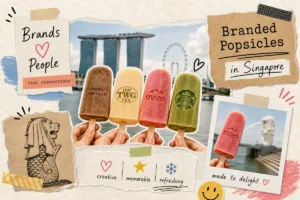
Tier three is a different category entirely. Here, the dessert is the campaign idea. Vendors engineer custom product forms, build proprietary moulds, and produce edible assets that are brand-accurate and designed specifically for social sharing. The product does not carry your brand; it is your brand, in edible form. Only a limited number of vendors in Singapore operate at this level. The capability gap between tier two and tier three is wider than most event planners expect before they have run a brief through both.
What most vendors can and can’t deliver for a brand activation
Customisation depth: where most vendors tap out
Many Singapore dessert catering vendors stop at printed cups and flavour choice. True product-form customisation, where your logo, mascot, or product shape is reproduced as a three-dimensional edible object, requires in-house mould engineering capability. That is not something most vendors have, and few will openly admit they lack it. If you brief a standard cart vendor for a logo-shaped popsicle, there is a real risk they will outsource the work, add margin, and lose control of quality and lead time in the process. Ask any vendor you are considering to walk you through their mould production workflow and provide sample lead times before you commit.
Halal certification: more complex than a sticker on the cart
Halal certification for corporate events in Singapore means more than a MUIS certificate framed on a wall. It means certified ingredients, a certified kitchen, certified production workflows, and documented traceability that procurement teams can verify. Many vendors carry basic halal certification for their café products but cannot produce the full documentation required for government events, statutory board dinners, or large corporate events with Muslim attendees. This gap can create a serious compliance problem at the worst possible moment, which is usually two weeks before an event when the approvals process has already started.
Social media output: a design discipline, not an afterthought
Generic dessert catering rarely generates organic social content at scale. People tend to photograph something that looks like a miniature version of their favourite brand’s product, not a plain scoop of vanilla. Building social shareability into the dessert requires design thinking from the brief stage, not at the point of plating. The vendor you choose needs to understand brand guidelines, not just menus. Most caterers read menus. Very few read brand guidelines.Check out this event done by COACH Singapore with their Tabby 3D Popsicles https://www.instagram.com/p/DXBezfDj1j_/
Where Scoopy’s & Cream is genuinely different
In-house silicone mould fabrication: the capability gap
Scoopy’s & Cream engineers custom 3D popsicle moulds entirely in-house, from client logo or product form through to finished edible asset, without outsourcing the production process. The workflow runs from brief and file review through master creation, silicone mould build, and sample casting, all within their own production facility, with QC at each stage. That matters for three reasons: lead-time control, brand accuracy, and the ability to iterate on a brief without third-party delays. For luxury brand activations where Pantone accuracy is non-negotiable, this level of internal control is a meaningful operational advantage. Scoopy’s & Cream has executed activations involving brands such as COACH, DIOR, Louis Vuitton, and Nike through its fleet ecosystem, and demanding brand teams do not give repeat briefs to vendors who get the colour reference wrong.
Experience with demanding luxury clients: a different standard of brief-handling
Most dessert vendors learn on the job at birthday parties and small corporate dinners. Scoopy’s & Cream has built its operational standards over years of executing activations for brands that will pull a vendor off-site if the product does not match the brief. Those years of experience produce a standard that generic caterers simply do not develop. It also shapes how the team approaches a brief: they ask about brand guidelines first, not flavour preferences. This is a small detail that tells you a great deal about how a vendor actually thinks about your activation.
Halal certification and procurement-ready documentation
Scoopy’s & Cream offers halal-certified catering and can provide procurement documentation on request. For corporate clients running inclusive events, and for government or GLC procurement teams with vendor registration requirements, this means halal certification, RAMS documentation, government vendor registration confirmation, and corporate invoicing structures are available when needed. This removes the compliance risk that creates problems for event planners when a lower-tier vendor cannot produce the required paperwork three days before a statutory board dinner.
How to shortlist the right vendor and request an accurate quote
Four questions to answer before you send a brief
Before you email any vendor, answer these four questions about your brief. Does the dessert need to be brand-specific in form, or just branded in presentation? Are halal certification and compliance documentation required for your audience? What is the expected headcount, and is there more than one service location? Is social media content generation a stated event objective? Your answers will indicate which tier of vendor you actually need, and which vendors can realistically execute the brief without outsourcing the parts that matter most.
What a useful vendor response looks like
A strong vendor response addresses your brief directly, proposes a specific format rather than a generic package, confirms halal status with documentation available on request, and provides a clear breakdown of inclusions. Vague responses, “we can customise, contact us for details”, signal a vendor selling off a standard menu who will struggle with a specific brand brief. A useful benchmark: look for a response that includes a capability statement, a mould feasibility assessment, and a procurement document checklist. That level of specificity is what separates a serious edible brand experience vendor from a generic caterer.
A quick-reference checklist before you commit
- Custom product form required? Confirm in-house mould capability, not outsourced production.
- Halal certification needed? Request full documentation, not just a certificate copy.
- Government or GLC event? Confirm vendor registration and RAMS availability.
- 200+ guests? Ask about multi-station scalability and logistics model.
- Post-event content in scope? Ask to see previous social media outputs from comparable activations.
The short version
If your brief is a staff party dessert, tier one is fine and you are not overpaying for capability you do not need. If your brief is a brand activation where the dessert is part of the campaign creative, you need a vendor who engineers rather than caters. Those are genuinely different capabilities, and the price difference reflects that.
When evaluating how Scoopy’s & Cream compares to other experiential dessert vendors in Singapore, the distinguishing factors are concrete: in-house 3D mould fabrication, a track record with demanding luxury brand clients, halal-certified catering with procurement documentation available on request, and a dessert pop-up service in Singapore that is built around brand briefs rather than standard menus. That combination is not common among mobile dessert activation providers in Singapore. For most tier-three briefs, it is worth benchmarking directly against the field.
Use the checklist above to brief two or three vendors and compare their responses carefully. You will know quickly which tier each one actually operates in. The vendor who addresses your brand brief directly, proposes a specific format, and provides compliance documentation without being asked is almost certainly the one worth talking to further.